Effective Date (last update): October 10th, 2026 @ 21:58pm UTC+2
quasi natura, nomen sibi dedit: Earth; sui tou-nomini: Milky Way, galaxy
2026-10-10T21:58:XX.XXX+02:00——————————————————
Music: Resources & Downloads
——————————————————
Are you self-taught?—Well this entire resource-page is most definitely for you!
This guide is a complete cheat-sheet: but you’re going to have to commit to the relevant parts! No non-sense; all my secrets!
—Look for “CHEAT SHEET”, when seeking out tips—
—Otherwise, look for “RESOURCES”, when seeking out videos or links & activities—
———————
——————————————————
Sections:
——————————————————
1. Singing Resources
2. Piano & Midi: “The 'Plan'”
3. [Music Production] Digital Audio Workstation (DAW)—Resources & Plugins
4. Games & Stuff
——————
[Work In Progress]:
1. DJing: from “Listener to Universal Tastemaker”
2. Guitar: “String Theory”
——————————————————
———————
Music is for everyone.
So make sure you remove those muddy shoes by the door; seize and enjoy every healthy and bold new opportunity you encounter!—Be a person!
“If it weren’t for dancing: I would have never made music; if it weren’t for sound design: I would be genre hard-stuck; if I were, you never have to be.”
—Doom Dudash
——————————————————
[DISCLAIMER]
——————————————————
Browse-browse-bowser?!—NO, Star!!!
By clicking any external links on this website, you are officially leaving our cozy digital living room and stepping into the wild, untamed wilderness of the broader internet.
While we only link to cool, helpful, and interesting places, we don't own those websites, we don't sleep over at their houses, and we definitely don’t control what they do. Once you click away, you are subject to their rules, their cookies, and whatever weird fonts they decided to use.
If a third-party link takes you to a broken page, a questionable conspiracy theory forum, or an endless loop of dancing cat videos, we cannot be held responsible (though we do highly recommend the cat videos). Browse safely, pack a snack, and remember to look both ways before crossing the digital street!
——————————————————
For further information, please see our terms and conditions (if you’re directly looking third-party links)
——————————————————
———————
——————————————————
Singing Resources
——————————————————

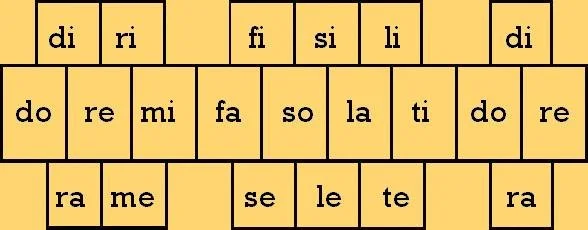
(Source: https://howtosingsmarter.com)
Solfège (Latin/Romance) System: in the Fixed Do solfège system—Do equals C, Re equals D, and Mi equals E —
- Alphabetical (English) System: uses letters: A, B, C, D, E, F, G;
- German System: uses letters like the English system, but replaces B-natural with H and B-flat with B;
- Sargam (Indian Classical) System: Uses syllables Sa, Re, Ga, Ma, Pa, Dha, Ni.
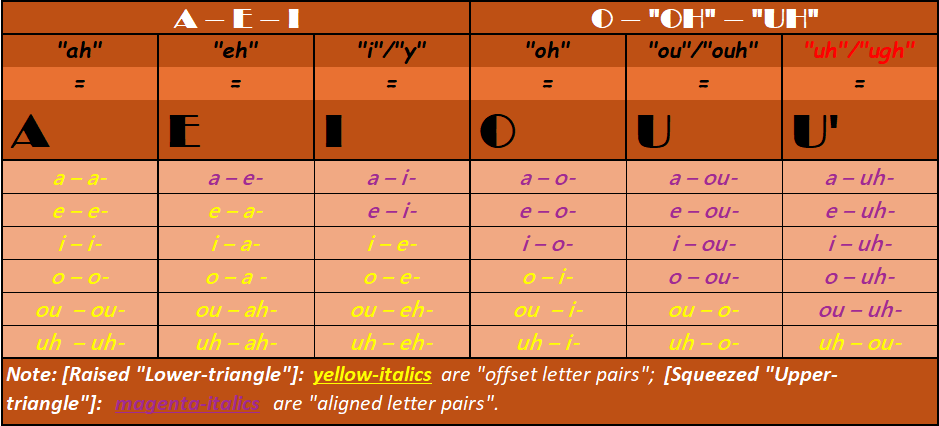
There’s still more if you do your own research using the words “speech pathology” and “consonants”; there are primary and secondary consonants that can be “layered together.”
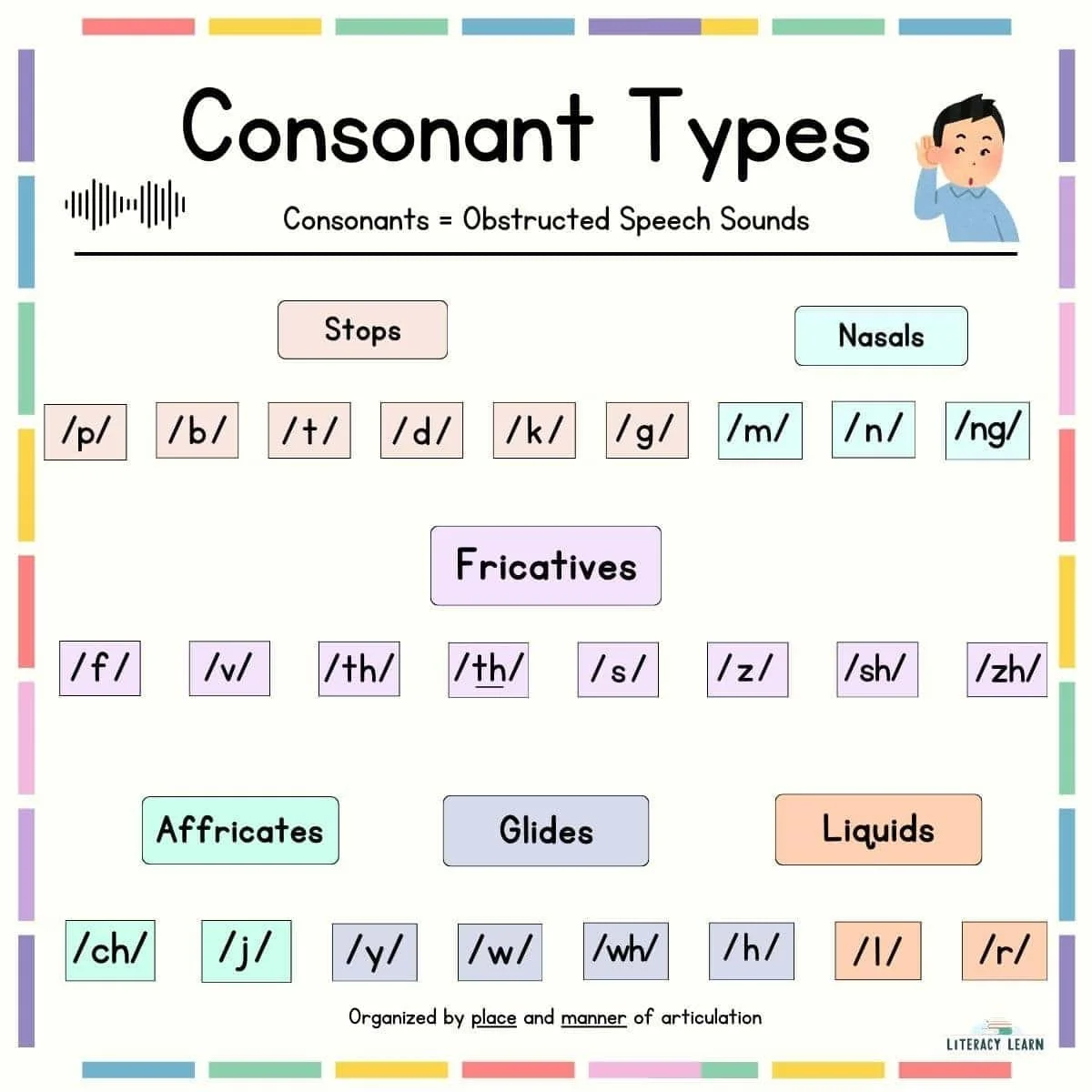
(Source: https://literacylearn.com)
—Riffs & Runs: A E I O U; do every vowel, play it multiple times—
Try to make a warm-up and cool-down routine if you’re really going at it!
Not the same as a throat lozenge:
Here’s a reddit post about “vocal steamers vs nebulizers”: https://www.reddit.com/r/singing/comments/1jkym0h/vocal_steamers_vs_nebulizers/ (read up somewhere else on how to clean your stuff; seriously, learn to clean).
—[u/L2Sing]: “Steamers are generally recommended for singers.”:
“Nebulizers are generally used as a vehicle to deliver medication to the lungs.
They also require you to keep saline on hand, because you should not use water with a nebulizer.” (from reddit.com/user/L2Sing)
RESOURCES:
——————
Videos
——————
Videos:
Perfect Pitch Training - All Keys - YouTube (Train your ears; left, right, and both simultaneously. Beware of how you use your headsets and earbuds because to get the maximum out of ear training and your proprioception you’ll want to train 3 manners; space out your ear training over time and avoid ear fatigue).
———————
——————————————————
— Quick Tip —
CHEAT SHEET:
——————
Brain & Dexterity
——————
Brain: Speech Synchronicity; & Dexterity: Keyboard Reversal
[Piano]: Try to learn how to walk through your major and minor chords first. Thus, you may use the spacing to easily walk through all keys and modes while: playing up then down, all 7 notes of your octave + the extra octaves (to further engrain the active recollection of tone-and-tune-to-muscle memory); spelling out to yourself the alphabetic-note—and/or, then, the solfège-note—that you are playing.
Furthermore, did you know that a lot of us learned to count better or best from playing the universal instrument we’ve called the piano?! Count your 3s your 5s your 7s and your +/- 2s!
A dragon once whispered to me that if I turned my piano around I would be able to accelerate my learning… Not by learning my songs backwards, but first and most patiently remaining wise to the process. Indeed I cannot afford a grand piano, so you won’t find me resting atop any such piano’s casing or rim. He must have meant a midi controller I believe… I can’t imagine doing this on an upright piano’s tall tail for a back (its backpost)…
Dexterity: Guitar Body, On Head And Stomach; & Brain: Vibrational Recognition
[Guitar]: I advise players to lay their guitar body along them as you play it laying down, perhaps in bed. With the guitar laying along your bust, with the fret placed on your forehead: guitar tuned, pick-n-strum individual strings “while spelling out to yourself the alphabetic-note—and/or, then, the solfège-note—that you are playing.”
As you let each strum resonate through your physical body, you’re encouraging your ears and body to recognise these pitches. This stimulus, is one to self-employ intelligently, as you wouldn’t want to become overly sensitive!
As you simultaneous hear and feel the alignment of each string’s tuned frequency and doppler: furthermore, notice the changing harmonic “screams” (@danisophia.official) or dynamics resulting along each pluck or strum. The distances that each strum’s pluck has on that very same tuning’s tension is capable, and especially notable—on an electric guitar—to harness the extent of any string-under-tension’s harmonics. You’ll get an AWESOME screaming sound out of your playing!
——————————————————
———————
RESOURCES:
——————
More Videos
——————
More Videos:
Vocal cooldown exercises (5 exercises to REPAIR your voice) - YouTube
15 minute vocal warmup - complete warmup sung by a female singer - YouTube
— None of this or these is sponsored content. —
——————————————————
Piano & Midi: “The 'Plan'”
——————————————————

(Source: https://piano-music-theory.com)
Clef: Treble; sharps & flats.
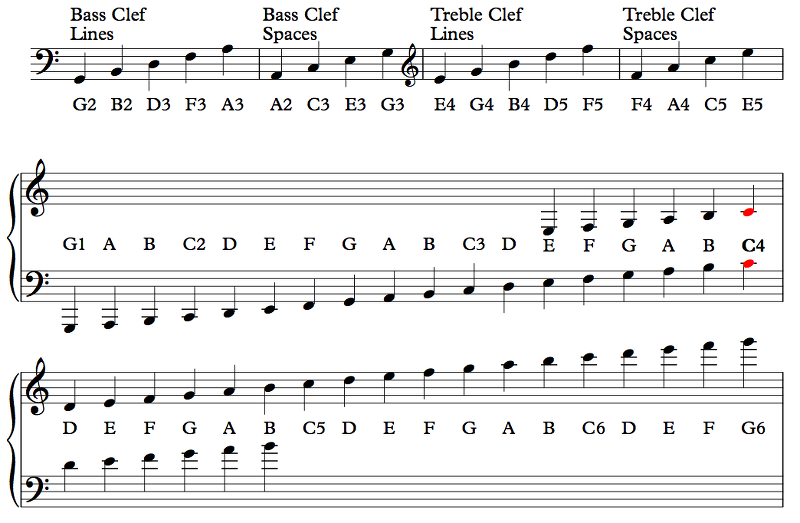
(Source: https://offtonic.com/theory/book/1-3.html)
101: “How to read sheet music.”
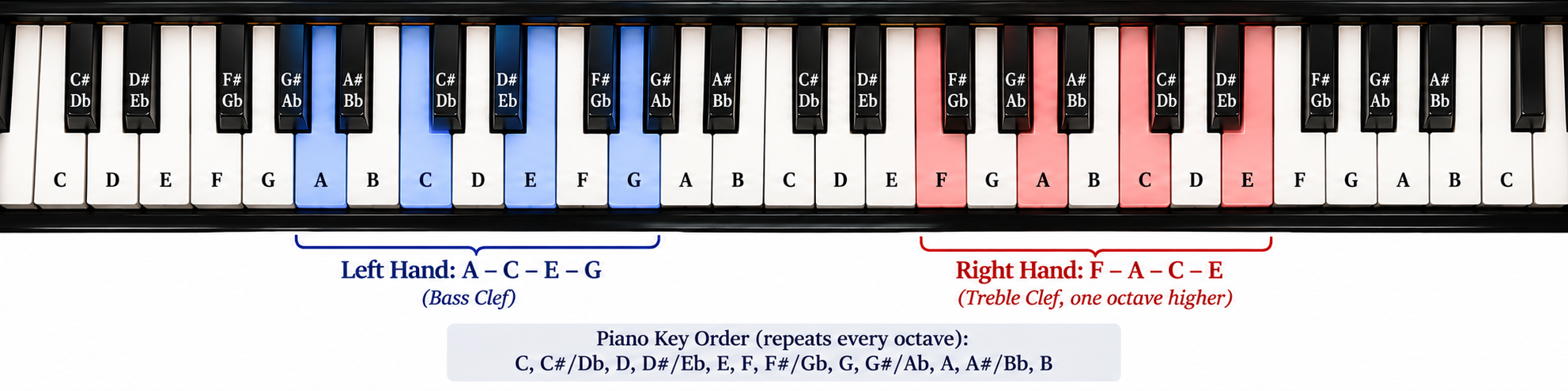
Treble & Bass Clef: The Musical Staff’s “spaces” finger-layout diagram; for their respective staff position and notes (noteheads, stems, & flag/beam; there are also Treble-treble or Bass-bass Clefs on staves):
Treble Clef (G Clef)—
- Lines (bottom to top): E – G – B – D – F (Every Good Boy Does Fine);
- Spaces (bottom to top): F – A – C – E (spells FACE).
Bass Clef (F Clef)—
- Lines (bottom to top): G – B – D – F – A (Good Bikes Don't Fall Apart);
- Spaces (bottom to top): A – C – E – G (All Cows Eat Grass).
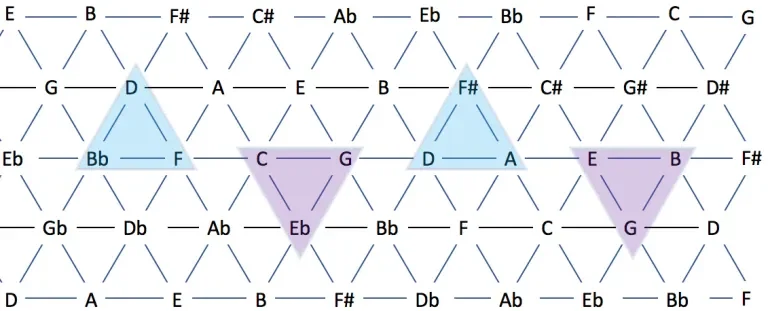
(Source: https://musictheorymanual.com/nrt-tonnetz)
“Tonnetz”: German, for a tonal net (a chord network):
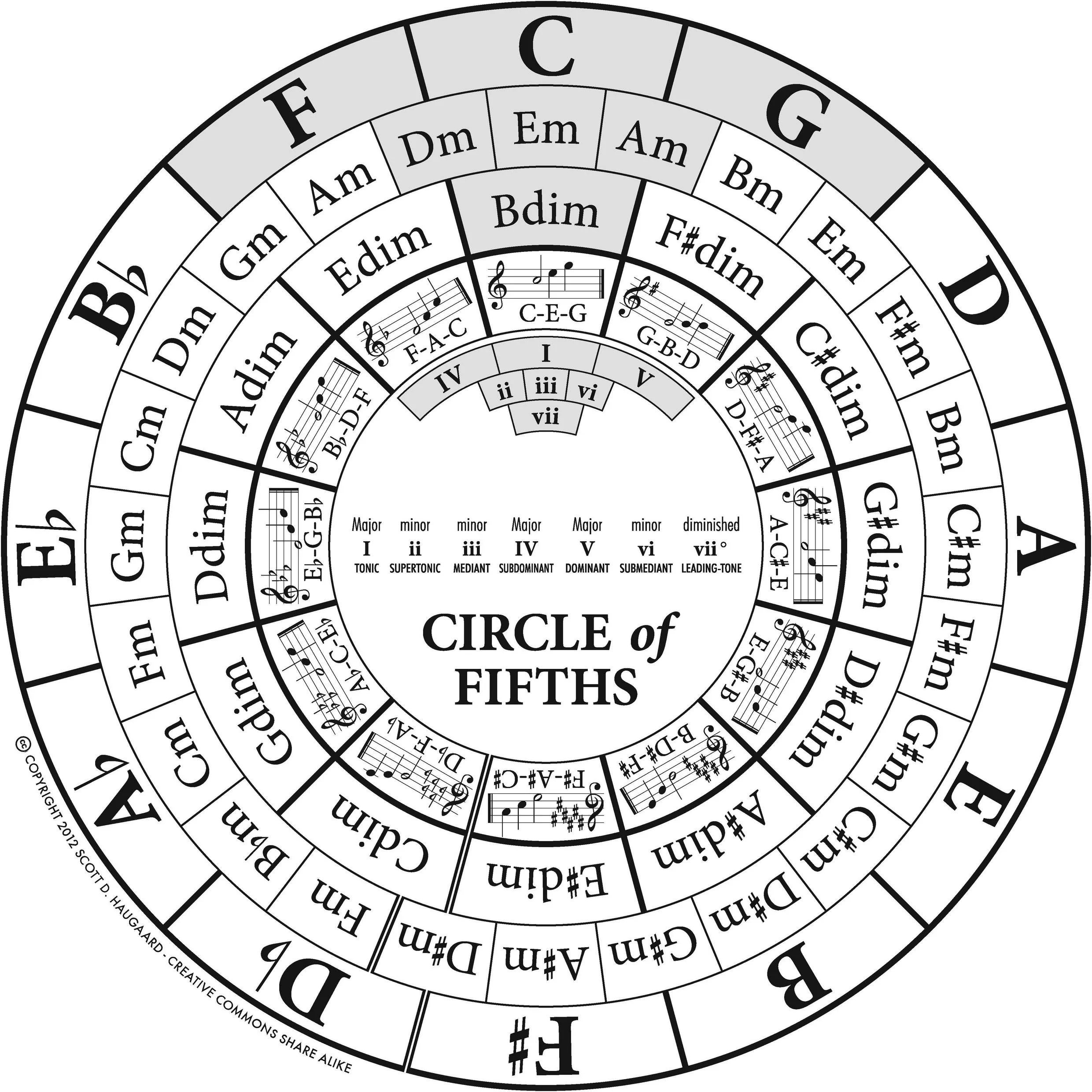
Where you’ll apply your order of sharps & flats (the order of “leading tones”)… use this to read a “circle of fifths”—
[Order of Sharps and Flats]:
F – C – G – D – A – E – B || B – E – A – D – G – C – F (it cycles, as Naturals then of Sharps or Flats; read the entire section).
—
Moving through the “order of sharps” goes up by perfect fifths; and,
Moving through the “order of flats” goes up by perfect fourths.
(Source: https://www.reddit.com/r/ukulele/comments/1jvnfzu/songwriting_tips)
Circle of Fifths: Organizes the 12 musical keys in a circle where each step is a distance of a perfect fifth; “diatonic chord degrees by position.”
———————
——————————————————
—Play aloud play with your headphones, today nevertheless record yourself because you can! We learn faster.—
“The piano is the ultimate architectural plan (piano) for Western music. It lays out a flat physical plane (piano) of keys where the levels (piani) of pitch are perfectly mapped out for the human ear” (because piano in Italian translates to plan or floor in English).
“il piano del terrazzo” <=> “the terrace floor”
=> [Noun]: A plan, a project, a design, a physical plane, or a floor/level of a building.
=> [Adjective]: Quietly, slowly, smoothly, or flat.
——————
CHEAT SHEET:
——————
Literature
——————
Tonnetz (by @mance_nk): “… this was really important in the 1800s especially to show what they called harmonic dualism; where a minor chord was the reflection of the major chord.”
e.g.: C-Major Chord (simply called a C-Major): {C, E, G} ({Do, Mi, Sol})
Terminology: ~“Transformations (keeping 2 notes the same and moving just one) — P-transformation, for parallel transformation (if C-Major, then its E to an Eb is a C-Minor chord; “C-Major’s parallel minor”). R-transformation, for relative transformation (if C-Major, then its G to an A is a A-Minor chord; “C-Major’s relative minor”). L-transformation, for leading-tone transformation (if C-Major, then its C to a B is a E-Minor chord; “C-Major’s leading tone”).”
Hugo Riemann (1849-1919; German musicologist and composer):
Formally speaking, today, if you are to use the word exchange instead of transformation, only one begets the term exchange. As it appears, it’s only the leading tone; called Leittonwechsel. My hypothesis or extension would be to say that if you are going to employ all 2 of these rooted Modulations, call it an exchange (where one is strictly a modulation; “When a piece moves through different pools of 7 notes one after the other, it is called Modulation”):
“if you are to use the Neo-Riemannian theory (employing a dialect and terminology directly translated from Hugo Riemann), you must use the original German-derived terms to be academically correct: Leittonwechsel, Relativ, Parallel.
——————————————————
———————
CHEAT SHEET:
——————
Piano: Sight Reading & Hand-location Correspondences
(“To be seen and studied with the pictures too!”)
——————
Cheat Sheet—Starter-pack: [Part 1] - “Major/Minor”:
[“Feel free to skip!”]: All Major, Minor and Diminished Chords in 10 minutes : Piano Tutorial - YouTube (a first?; nothing special, just a soft and beginner listening experience)—motive: “Love the little things!”
Piano chords: major and minor - YouTube (THUMB(LH-G||RH-C) – MIDDLE(E) – PINKY(LH-C||RH-G): you can walk through all the Major by maintaining that position; upon shifting your middle finger down a “half-step” you can walk through all the Minor chords. Know your Major progression and you Minor progression “whole-halves” to immediately recognise that you can play through all 7 notes from those positions)—-stay disciplined!
Diminished (vii°): shift Finger 3 AND Finger 5 down 1 half-step (C – Eb – Gb);
Augmented: shift Finger 5 up 1 half-step (C – E – G#).
Cheat Sheet—Starter-pack: [Part 2] - “Playing the Roman Numeral Chords (I to vii°)”:
—Where, in desired preparation for using a chart like the “Circle of Fifths”; best if you’re gravitating towards a Digital Audio Workstation (DAW)—
Take your root chord in “fixed Do”/C Major (C – E – G) and keep moving “those fingers” across the “white keys”, or up and along each scale degree (position of note in 7 note scale) of the C Major scale; at every next scale degree, its occurrences have their own name (see below) and each in of a chronological sequence will be your current or next Roman Numeral Chord (I - vii°)—
I (C Major): C – E – G. (Standard 1–3–5 major shape).
ii (D Minor): Move your whole hand up to D. Play D – F – A. (Automatically a minor shape on white keys).
iii (E Minor): Move your whole hand up to E. Play E – G – B. (White-key minor shape).
IV (F Major): Move your whole hand up to F. Play F – A – C. (White-key major shape).
V (G Major): Move your whole hand up to G. Play G – B – D. (White-key major shape).
vi (A Minor): Move your whole hand up to A. Play A – C – E. (White-key minor shape).
vii° (B Diminished): Move your whole hand up to B. Play B – D – F. Because F is a white key (instead of F♯), Finger 5 is naturally shifted down a half-step, giving you the diminished chord automatically.
RESOURCES:
——————
Videos; Tutorials, Make Your Own, Game
——————
Tutorials:
10 beautiful piano pieces - YouTube (get an idea of midi visuals or of types; perhaps spread you wings).
Yiruma - River Flows in You - YouTube (a beautiful song to follow along to. Recognise your scales as you play iconic songs; at times, take a minute to notice when songs are strictly constructed with the expected 7 notes of a scale and when notes voyage beyond).
The original piece is written in A Major (which shares its key signature with F-sharp minor).
The 7 Notes: The scale uses the notes A, B, C♯, D, E, F♯, and G♯ (it strictly uses one 7-note pool).
Yann Tiersen - Comptine d`un autre ete - l`apres-midi - YouTube (practice the “winged motion” of the bass notes first on both hands; probably the one thing that differs from typing well and transferring that skill to piano).
W. A. Mozart - Piano Concerto No. 20 (Allegro) [Piano Solo Tutorial] - YouTube
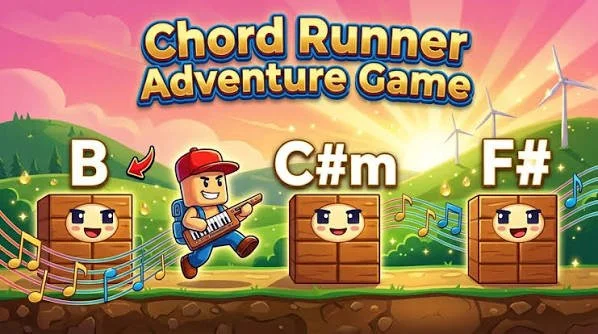
LEARN BEETHOVEN "Piano Sonata No. 1 in F minor, Op. 2 No. 1" - YouTube (insta: @aspiratwunk—Game: “Chord Runner”)—you’ll feel smart with this one. (Sorry for the quality.)
Chopin - Fantaisie-Impromptu (Op. 66) - YouTube—super agility dexterity!
Make your own:
Website: Piano VFX ; [Direct link to the download page (last used 09.10.2026; MM.DD.YYYY)] Piano VFX Basic by Piano VFX
Browser/Webhosted Piano; sounds for Midi:
Website: Midiano ; [Midiano: browser piano] app.midiano.com
Website: Chord Runner - Home ; 🎹 Chord Runner — Play Demo (press the eyeball to see the chord quality you need/needed to match).
——————
What’s missing?—Tone Equal Temperment (TET), under the Equal Divison of the Octave (EDO)…
That’ll be for the Guitar section and “string theory” (see Tت。; and soon for guitar—Guitar: “String Theory”, ON THIS PAGE).
How fun!
This would also be the place to take our understanding of music and life/society or the universe: beyond!
There will also be a DJing section in homage of the transcendental reality that avid and extensive “AUXing”, playlisting, and tastemaking has provided us globally (DJing: from “Listener to Universal Tastemaker”).
We’ll come to see or know more about 12-EDO, 19-EDO, 31-EDO, and 53-EDO; someday!
— None of this or these is sponsored content. —
——————————————————
[Music Production] Digital Audio Workstation (DAW)—Resources & Plugins
——————————————————

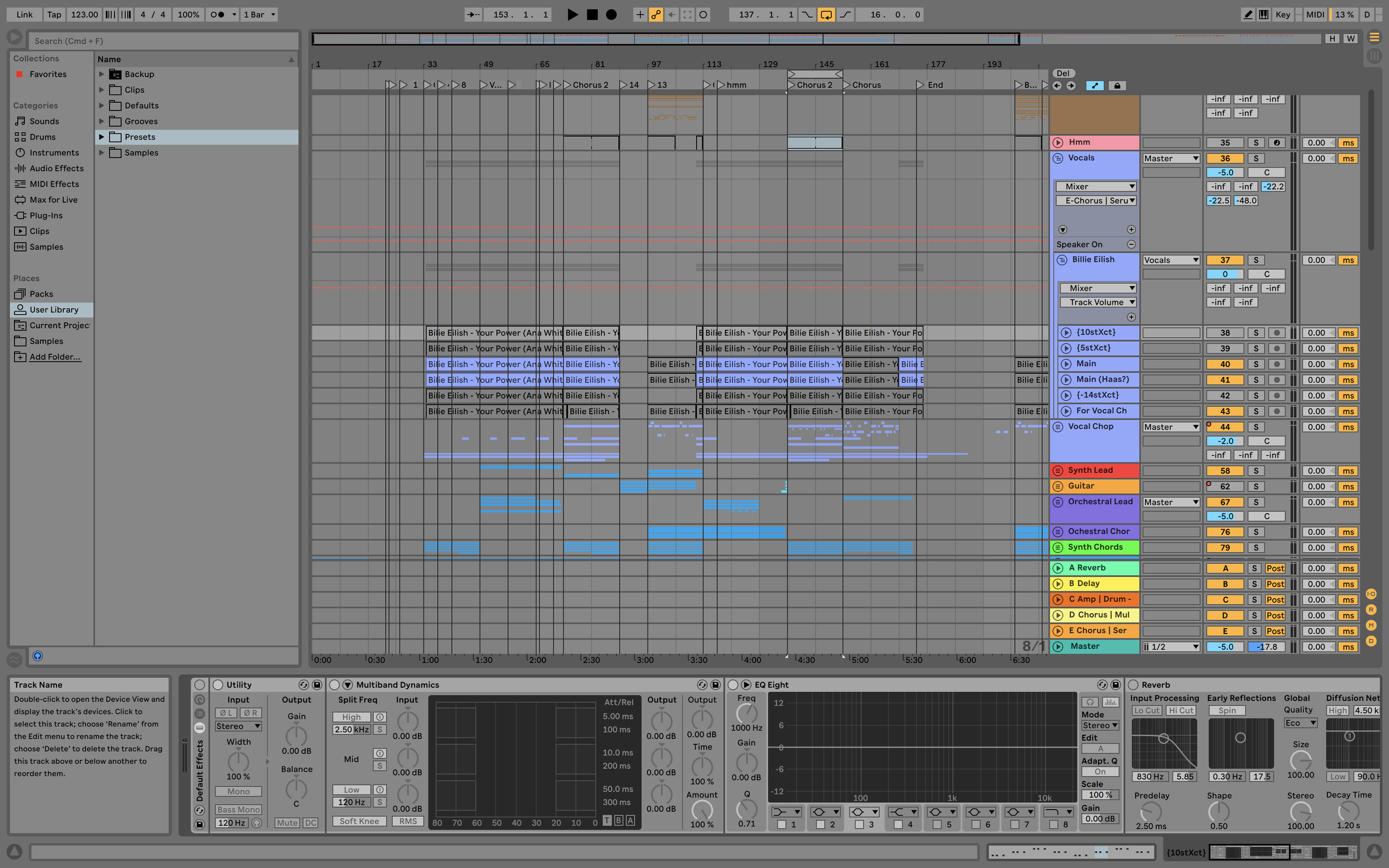
Ableton Live 12—
Billie Eilish - Your Power (Ana Whiterose Cover; Doom Dudash Remix).
—Try a Digital Audio Workstation, but beware of temptations that comes with prerecording. It’s also a must; prerecord: practice!—-
RESOURCES:
——————
Software, Networking, DJing/Stem-extraction
——————
Digital Audio Workstations (music production; the software):
FL Studio (my first);
Ableton Live (my current);
[Mac Only]: Garageband (“offered”, on mac; mac only; midi-to-score included);
Pro Tools (by Avid);
[Mac Only]: Logic Pro (mac only);
Cubase;
Reaper;
Studio One;
Reason (my older sibling breifly attempted this one with DJ Paride Saraceni when we were young; check him out on Spotify!);
Bitwig Studio.
Networking:
[Splice]: Royalty-Free Samples, One Shots, Sound Effects & More | Splice (the #1 Hub for Networking among and amongst musicians & producers).
ECOSYSTEM: COLLABS, REMIX CONTESTS; CLOUD PROJECT SHARING, SECRETS AND MORE!
Free Stem-extraction/DJing (remixing):
VirtualDJ - The #1 Most Popular DJ Software (this is where I started my first spins, in my dorm room; before my first DJ controller).
There is no more need to do it manually; which resulted in many artifacts or sibilance, yet one might discover that with patience, even careful attention to artifacts may guide. Resampling can make leads, voices, basses, chords, percussions—anything! Where attempted, exploration even void of mastery may impart with a divination.
“Purchase A Template” & Soundpacks:
Highly recommended to individuals learning music production’s the ins-and-outs; for tricks, stylings, and a genuine guaranteed hint at the sufficiently efficient and of good grace in professional formatting.
Cymatics.fm - The #1 Site For Samplepacks, Plugins & More!;
REMIX CONTEST, SOCIAL MEDIA NETWORKS; SECRET GROUPS, AND MORE BY MANY NOTABLE PROFESSIONALS!
This is where I began sharing almost every secret and technique I would ticker at (from my daily obsessive grind); replying to as many questions as possible as soon as they showed up across the groups and the various.
I really enjoyed their Signal Remix Contest (last edit: “March 8th, 2017”)—it was fun and their sounds are “p-adic” crisp!
Royalty Free Ableton Templates and Remakes by Abletunes.
Where I learned to compose one of my earliest master-chains; before Cymatics & Splice existed!
RESOURCES:
——————
Plug-ins
——————
Plug-ins:
A Must, for ALL—
Chord Analyzer | Dusk Audio (informational, piano/midi; free);
Extreme Usefulness—
[Paid; my favourite] Serum 2: Advanced Hybrid Synthesizer (virtual synth; a paid plugin) (I haven’t tried it yet; I used to use Serum 1);
XferRecords.com | Home of the Xfer Records VST Suite (suite; free);
Home | LennarDigital (virtual synth; free);
[Paid] AutoTune: The Best Pitch Correction & Vocal Chain Plugins (mix-in-key; pay);
[Paid] FabFilter - Quality Audio Plug-Ins for Mixing, Mastering and Recording - VST VST3 AU CLAP AAX AudioSuite (full suite; pay);
[Paid] RX – iZotope—THE MASTERING SUITE’s BEST PART; if you’re on a budget, I’d recommend the steeper learning curve and would thus propose this over Sound Radix Pi and its other software.
Beginner-to-Intermediate User Usefulness (perhaps a pro trick with SoundRadix “Pi” @ value 1… for some odd reason…)—
[Paid] Sound Radix (mixing suite; pay)—listening to your FIRST EVER “perfectly spaced mix” from your own selection of sounds and settings does not compare. Get this one, for what’s called: “Pi”!
[Paid] Nicky Romero Kickstart 2 - The fastest plugin for pro sidechaining (compression or gating, sidechain compression; pay) (I haven’t tried 2 yet)—Kickstart 1 was super cool! This was especially great I was still learning to sidechain and for when I lacked discipline or the lasting, meaningful (as if to when I end up starring in my own adage or morality); as it is known that simplicity from ease-or-habit may “Witcher” to flounder mockingly, painstaking. Rumor has it Kickstart 2 allows for compression tricks with a few tweaks—pretty huge;
Fun (but useful)—
[Paid] Sausage Fattener Plugin - Dada Life (compressor/saturator/overdrive; pay);
Others—
[Paid] Ozone 12 Advanced - Go Beyond Other Mastering Plugins – iZotope (virtual synth; pay) (I haven’t tried it yet)
[Paid] Massive - polyphonic software synthesizer - Komplete – Native Instruments (virtual synth; pay);
[Paid] CLA-2A Compressor Limiter Plugin (compressor; pay) (I haven’t tried it yet);
[Paid] Vital - Spectral Warping Wavetable Synth (virtual synth; pay) (I still haven’t tried it yet);
[Paid] Valhalla DSP | Reverb & Delay Plugins (reverb; pay) (I haven’t tried it yet)—apparently it boasts THE MOST lush reverb on the market;
[Paid] Arturia - Sound Explorers | Hardware & Software Instruments (suite?; pay) (I haven’t tried it yet);
[Paid] Spectrasonics - Omnisphere - Overview (virtual synth; pay) (I haven’t tried it yet).
—I’ll be sure to seek out more free content, but for now I’m applying as much of my math, physics, and experience to make music with as many stock plug-ins as possible (even though Ableton’s stock-plugins hardly feels like it—huge leap on Ableton Live 9 2013-’18 stretch alongside Andrew & Emma Simper, as Cytomic); but please come-back soon for updates (or join along with me and have a read at Andrew & Emma’s technical papers as I did; try “Trapezoidal Integrated Filters”, for binary-stepped square or sine time-continuous real-world smooth: it all has character | compare “Trapezoid” to Simpson’s rule on composite sums; a sum-approximation as to that which makes the definite integral from a to b); these were for me, “the grain of salt” which made “the marmite-soup” (… bad french). Yes, the courage to lool up on the dithering algorithms built into Ableton (POW-r 1, 2, 3). That’s the algo which finishes a perhaps desired polish to our tracks with choice of “contravarient” noise. Know to be patient with those)!
— None of this or these is sponsored content. —
——————————————————
Games & Stuff
——————————————————
RESOURCES:
——————
Fun & Productivity
——————
Typing:
[Free]:
[Featuring over 100 languages]: Monkeytype | A minimalistic, customizable typing test, contribute your own quotes via their GitHub (my favourite—simplest and best interface; SELECT QUOTES—for full “intelligible” sentence sets);
[Paid]:
Ratatype — Online Touch Typing Tutor and Typing Lessons (has a free language option);
Check your WPM score with a free one-minute test - Typing.com (looks aesthetically pleasing and has a generic typing sound).
Games:
🎹 Chord Runner - Home (a game that teaches you the “Alphabetical (English) System” (uses letters: A, B, C, D, E, F, G) and learn all your Major and Minor Key Chords!);
choicer voicer - Google Search (This one I know exists but I can’t quite find a “reliable” link; beware of this one for it’ll have more “random” cookies and “Ads”).
VirtualDJ - The #1 Most Popular DJ Software [“wink-wink”]; then grab a midi-keys or piano, a guitar, or dawn to ex-imbue your voice; find your DAW and make it a lifestyle!
Longevity, health?—Or to become superhuman?!
“Frames Per Second; Sounds Per Second; Beats Per Minute; Breaths Per Annum; Effective Grain Rate Differential Per Somatoreceptor; Proprioception — Domain Expansion” (pp. Future Bass (ה — He : [#5]); Tت。)
Other:
Browser Extension—for mouseover language translations (“we” currently support 55 languages):
Shazam - Music Discovery, Charts & Song Lyrics (works on your computer for free too; or get the application on your phone!).
— None of this or these is sponsored content. —